About
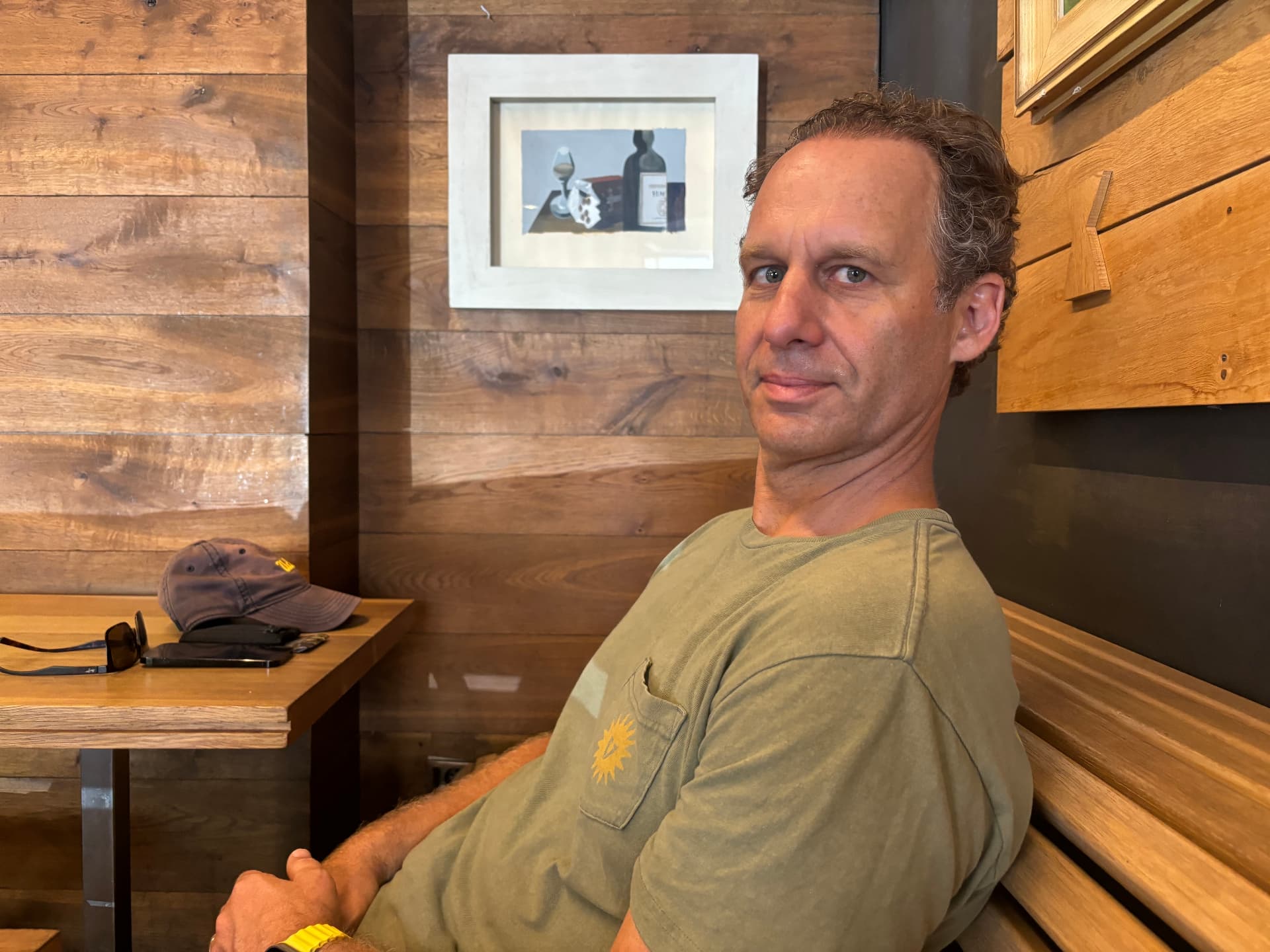
Hi, I’m Jonathan.
I ran someone else’s company, EMyth, for five years. I’ve run my own companies for the last ten. Before either of those I was a lawyer who left, and spent a long time doing two things at once that I thought had nothing to do with each other.
They had everything to do with each other. That’s the one thing I’d stand behind after all of it: who you are and how you work were never two different things. A company gets exactly as honest as the person running it.
Before any of it
Two tracks at once
I started out as a lawyer. Then I did what lawyers who don’t want to be lawyers do: business development, software, renewable energy. That was ten or fifteen years, and from the outside it looked like a career.
The other track ran on nights and weekends. All through the 2000s I was doing a different kind of work — meditation, yoga, somatic work, deep psychology, every authenticity path I could find, and a long unglamorous effort to understand what I’d carried out of my childhood. I wasn’t doing it to get better at my job. It honestly never occurred to me that the two had anything to do with each other.
They turned out to be the same track. I didn’t reason my way to that; I ran both for twenty years and eventually couldn’t tell them apart. Everything I’ve done since is downstream of it.
The turn
I was the smartest guy in the room
Or I believed I was, and I’d built a lot on believing it. It’s a useful thing to think about yourself right up until it’s the only thing standing between you and everything you can’t see about yourself.
The best decision I have ever made was setting it down long enough to learn from someone who could see me more clearly than I could see myself. Not handing myself over to them. Staying who I was, and letting them be further along the road than me.
That tension — how you learn from someone with real mastery without surrendering your own judgment, and how, if you never surrender anything, you never learn at all — is what I ended up writing a book about. It’s also why the dinners happen around a table instead of from a stage.
Running someone else’s
EMyth
In 2011 I got the job as CEO of EMyth. It was my first time as an executive and I held it for five years. EMyth was about building systems inside small and mid-sized companies, and the systems were interesting enough. The part I couldn’t put down was the people part: how do you build a place where someone is genuinely challenged, doing work at the right level, and actually being told the truth about how they’re showing up?
Because of that other track, I leaned hard on the telling-the-truth half. Kindly, but with an edge. Nobody had put a name to that yet. And the more CEOs I talked to, the more I heard they wanted the same thing and had no idea how to get it. I couldn’t build it inside EMyth — that brand was about something specific, and this wasn’t it. So I left.
Our managers knew they should be talking to people. They had been to the trainings and read the books. When it was time to have the hard conversation, they froze, or overreacted, or waited for the review cycle to do it for them. So did I, more often than I’d like to admit. The gap between knowing what to say and saying it turned out to be the most expensive thing in the building.
Writing it down
Good Authority
That gap became my obsession. I wrote Good Authority in 2016 to make one claim: the person who shows up at work and the person who shows up everywhere else are the same person, and pretending otherwise is why so much management advice quietly fails. It introduced The Accountability Dial, a five-stage way of saying the small thing while it’s still small.
It gets shelved as a business book. It isn’t, really. It’s a book about relationships — about how a person in charge uses enough authority to be useful and not so much that everyone around them disappears. I didn’t get that from management theory. I got it from the other side of it, as the student.
Seth Godin called it “a modern classic.” More usefully, people still send me photos of the margins. Since then I’ve spoken to rooms at TikTok, Amazon, Southwest Airlines, Okta and Panasonic, written for Harvard Business Review, and been named one of Inc.’s Top 100 Leadership Speakers.
Running my own
Refound, then Ren
I started Refound in 2016 — coaching, consulting and workshops, teaching this inside companies large and small. Nine years, and a genuinely good run.
It also showed me the ceiling. After a decade of workshops I kept watching the same thing happen: great room, real intentions, and by Friday the old habits were back. Nothing in the company was built to hold the conversation open once I’d left.
Ren started inside Refound as the answer to that. AI was the first thing I had seen that could actually be there on the Tuesday, and the opportunity was far too big to run as a side project. Two years ago I spun it out and went all in. In 2025, once Ren was properly on its feet, I closed Refound.
Today that company is Ren, where I’m CEO. Ren is a coach for the conversations people put off, built so the words arrive at the moment you need them, without me in the room. Running it is also how I keep myself honest. Everything I say at a dinner about growing a company, I’m living that week.
The table
Dinner
The most useful conversations I’ve had about any of this were never on a stage. They were with other people in the seat, over food, with nothing to sell each other. So a few times a year I have six founders to dinner, in a city near them, and we talk about what actually happens to a company once it outgrows everyone knowing everyone. No slides. I pick up the check.
It’s deliberately that size of company. Somewhere between fifty and five hundred people is the last stretch where a culture is still soft enough to shape by hand. At a thousand it has set, and changing it costs a fortune and usually doesn’t work. This is the room I care most about, and the one I’ve spent the most time in.
Off the clock
Encinitas, California
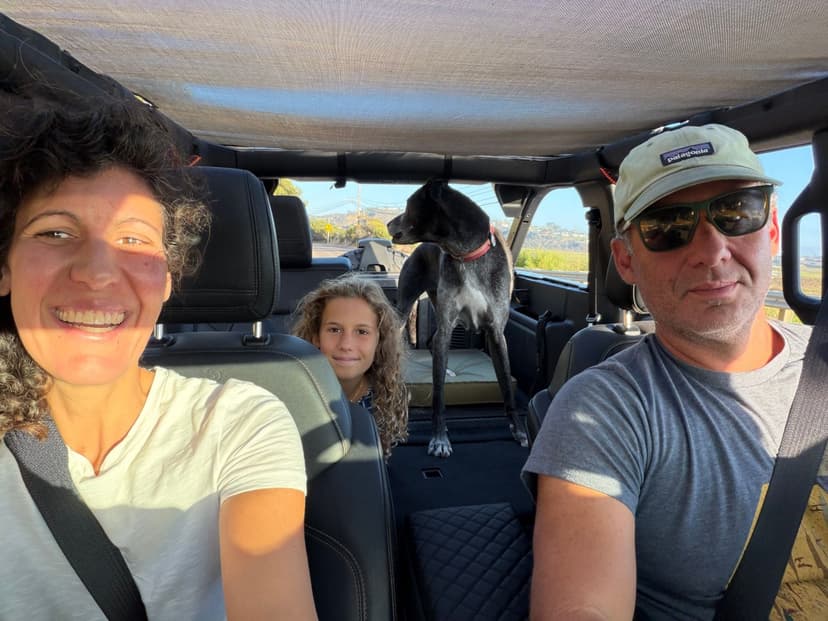
When I’m not working I’m in the water, on a trail, or in the Jeep with the top down, my family and the dog along for the ride. Most of what I know about hard conversations I learned at home first.


If this sounds like your company, let’s talk.